
How Furniture Construction Determines Lifespan
You're in a furniture store, looking at two children's bookshelves. They look remarkably similar. Both are white. Both have three shelves. Both are marketed as "solid wood." One costs $120. The other costs $380. You can't see an obvious difference, so naturally you're wondering: why would anyone pay three times more for what appears to be the same bookshelf?
Here's what you can't see from the showroom floor: how these bookshelves are actually built. The cheaper one is held together with cam locks and particle board screwed into compressed wood. The expensive one uses mortise and tenon joinery connecting actual solid wood pieces. Three years from now, one will be wobbling and falling apart while the other remains rock solid.
The difference isn't in how they look new. It's in how they're constructed underneath the surface, which determines whether furniture lasts three years or thirty years. Most parents have no idea what to look for because furniture construction isn't something we're taught to evaluate. We judge by appearance and price, then wonder why some pieces last while others rapidly deteriorate.
Understanding basic furniture construction isn't complicated. A few key concepts explain almost everything about why furniture either endures or fails. Once you know what matters, you'll never look at furniture the same way.
Materials: What's Actually Inside
The single biggest factor determining furniture lifespan is what it's actually made from, which often isn't what you think based on how it's marketed.
Solid wood means wood cut from lumber. A solid wood shelf is a piece of wood. Not wood chips glued together. Not wood particles compressed into sheets. Actual wood from a tree, cut into usable pieces. This is the gold standard for durability because wood is inherently strong, can be repaired, and improves with age when properly cared for.
Plywood is layers of wood veneer glued together in alternating grain directions. It's engineered for strength and resistance to warping. Quality plywood can be quite durable, especially in applications where solid wood might split or warp. But it's not solid wood, and it contains adhesives that may off-gas formaldehyde.
MDF (medium-density fiberboard) is wood fibers glued together under heat and pressure. It's smooth, takes paint well, and is cheaper than wood. But it's also heavy, weak when screws pull out, swells permanently when wet, and contains significant formaldehyde in the adhesives binding it together. MDF furniture has limited lifespan because the material itself is fundamentally weak.
Particle board is wood chips and particles glued together, the cheapest engineered wood product. It's what makes furniture affordable. It's also what makes furniture disposable. Particle board is weak, especially at edges where screws go through. It cannot be refinished or meaningfully repaired. Water exposure causes permanent swelling and crumbling. Most furniture that falls apart within a few years contains significant particle board.
The tricky part is that furniture can be marketed as "solid wood" while containing substantial amounts of particle board or MDF. The frame might be solid wood while shelves are particle board. The front faces might be solid while sides are MDF. Marketing emphasizes the solid wood components while downplaying the rest.
This is why you need to ask specifically: Is this entire piece solid wood, or are some components particle board or MDF? Which parts are which? A reputable seller will tell you honestly. Vague or defensive responses are red flags.
Joinery: How Pieces Connect
Even solid wood furniture fails if pieces aren't properly joined together. Joinery is how separate pieces of wood connect, and it's what determines whether furniture stays tight and stable or loosens and wobbles.
Dovetail joints are the traditional gold standard for drawers. The distinctive interlocking pattern you see on quality drawer construction actually creates mechanical strength. The joint gets tighter with use rather than looser. Dovetail joints in drawers mean the drawer will outlast everything else in the furniture.
Mortise and tenon joints connect frame pieces. One piece has a protruding tenon that fits into a mortise (hole) in another piece. When properly fitted and glued, this creates incredibly strong connections. Antique furniture built with mortise and tenon joinery often remains solid after a century.
Dowel joinery uses wooden pegs to align and strengthen joints. Quality dowel joints, properly glued and fitted, are very strong. However, dowel joints in cheap furniture sometimes fail because the dowels are undersized or poorly fitted.
Screws through particle board or MDF are the hallmark of cheap furniture. This is how most inexpensive furniture is assembled. The problem is that screws don't hold well in compressed wood products. They strip out with normal use. Once a screw hole is stripped, there's no good way to repair it. The furniture progressively loosens and eventually falls apart.
Cam locks and furniture bolts are those metal connectors you twist to tighten when assembling flat-pack furniture. They work for assembly convenience but create long-term problems. The constant stress of use loosens them. Retightening helps temporarily but damages the particle board around them, making the problem progressively worse.
Corner blocks and braces reinforce joints and add stability. Quality furniture includes these internal supports even though you can't see them. Cheap furniture skips them to save cost. The difference becomes obvious when you use the furniture, when one piece stays stable and another wobbles from day one.
Hardware: The Small Parts That Matter Enormously
Quality differences in hardware seem minor until you live with the results daily.
Drawer slides determine whether drawers glide smoothly or stick, whether they stay aligned or hang crooked, whether they hold up or fail within months. Full-extension ball-bearing slides cost significantly more than simple side-mount guides, but they transform drawer functionality and longevity. Cheap furniture uses the cheapest slides possible, which is why drawers stick and bind.
Hinges that remain tight and aligned versus ones that loosen and sag make the difference between doors that work and doors that frustrate. Quality hinges are often European-style concealed hinges with adjustment capabilities. Cheap hinges are visible, non-adjustable, and loosen with use.
Knobs and pulls might seem purely aesthetic, but poorly mounted hardware creates problems. When a knob is screwed directly into particle board, the screw strips out quickly. Quality furniture has reinforced mounting points or uses hardware that distributes stress properly.
The actual screws, bolts, and fasteners used matter more than you'd expect. Quality furniture uses appropriate fasteners for the materials. Cheap furniture uses whatever's cheapest, often screws that are too short, too thin, or inappropriate for the material they're penetrating.
Finish: Protection and Longevity
How furniture is finished determines how it withstands daily use and whether it maintains its appearance or progressively deteriorates.
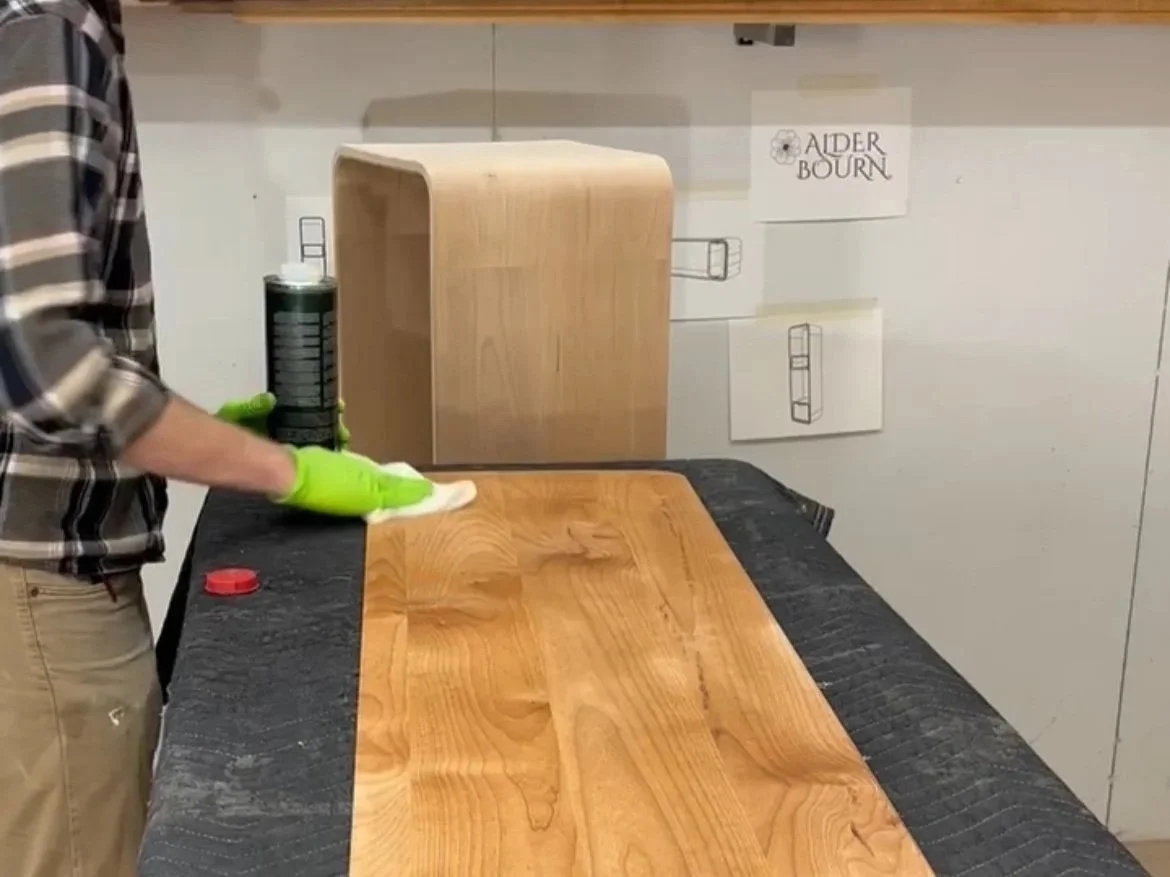
Oil-based finishes like Rubio Monocoat penetrate and bond with wood rather than coating it. This creates durable protection that doesn't chip or peel. When the finish eventually shows wear, it can be refreshed by applying more oil. The wood and finish become one integrated surface.
This is what we use at AlderBourn, and it's why our furniture can be refinished easily years later. The finish doesn't fail catastrophically by peeling off in sheets. It gradually shows wear in high-traffic areas and can be spot-treated or fully refreshed as needed.
Polyurethane and similar coating finishes create a protective layer over wood. When new, they provide excellent protection. But they're also brittle. They chip and peel with impact. Once the coating is damaged, moisture can penetrate underneath, causing further peeling and potential wood damage. Refinishing requires complete removal, which is labor-intensive.
Paint over particle board or MDF hides the underlying material but provides limited protection. Paint can chip, revealing the compressed wood underneath. More problematically, once the particle board weakens structurally, paint can't save it. The furniture fails regardless of how nice the finish looks.
Veneer over particle board is how cheap furniture achieves a wood appearance. Thin wood veneer glued to particle board looks like solid wood initially. But veneer can peel, especially at edges where it's most vulnerable. Damage reveals the particle board core, and there's no good way to repair it. The furniture still fails structurally even if the veneer remains intact.
Design: Form Following Function
How furniture is designed affects longevity independent of materials and construction.
Appropriate proportions provide stability. A tall, narrow bookshelf tips more easily than a wide, stable one. A table with legs positioned correctly stays solid, while one with legs too close together wobbles. Good design considers physics and actual use patterns.
Stress distribution matters in children's furniture especially. Kids climb, lean, pull, and stress furniture in ways adults don't. Design that anticipates this abuse survives. Design that assumes gentle use fails quickly when children are the users.
Solid backs and sides versus open construction affects structural integrity. A bookshelf with a solid back panel is inherently more stable than one with open back. The back panel prevents racking (side-to-side movement that loosens joints). This is why quality bookcases have solid or substantial backs while cheap ones have thin cardboard backing.
Accessible design that allows for repair extends useful life. Furniture designed so you can actually reach joints, tighten connections, and access internal components can be maintained. Furniture designed purely for easy assembly often can't be effectively serviced or repaired.
Weight: A Surprisingly Reliable Indicator
Here's a quick assessment method that requires no technical knowledge: lift the furniture. Quality solid wood furniture is heavy. Particle board furniture is also heavy but distributes weight differently and feels less substantial. MDF is surprisingly heavy for its strength.
But the weight-to-quality ratio is revealing. If furniture feels extremely light for its size, it's probably made from thin materials or hollow construction. Both suggest limited lifespan. Furniture that feels substantial and solid usually is substantial and solid.
This isn't absolute, there are exceptions, but as a quick field test when shopping, weight tells you something real about construction quality.
What to Actually Look For When Shopping
Now that you understand what matters, here's how to evaluate furniture without a degree in woodworking.
Ask specifically about materials. "Is this solid wood, plywood, MDF, or particle board? Which components are which?" Don't accept "wood" or "solid wood" without clarification. If the seller can't or won't tell you specifics, assume the worst.
Look at joints and connections. Can you see how pieces connect? Are there visible dovetails in drawers? Does the construction look substantial or minimal? In stores, gently test stability. Does it wobble or feel solid?
Examine hardware. Open and close drawers. Do they glide smoothly or stick? Do hinges feel substantial? Can you see how knobs attach? Quality hardware is usually visible evidence of quality construction throughout.
Check edges and corners. These are where cheap construction reveals itself. Poorly finished edges, exposed particle board, veneer that's already peeling at corners. Quality furniture has cleanly finished edges even where you don't normally look.
Research the manufacturer or maker. Companies with reputations for quality maintain those reputations by actually building quality furniture. Brands you've never heard of offering impossibly low prices are cutting corners somewhere.
The Three-Generation Test
Here's the ultimate measure of construction quality: could this furniture reasonably serve three generations?
Your child from toddler through teenager. Your grandchild after that. Maybe even your great-grandchild. Is the construction robust enough, the materials durable enough, the design timeless enough to actually make this possible?
Most modern furniture fails this test immediately. It's not designed or built to last thirty years, let alone ninety. And that's not an accident. Furniture that needs replacing every five years is more profitable than furniture that lasts for decades.
But furniture can be built to serve generations. Historical precedent proves this. Antique furniture built with proper joinery, solid materials, and thoughtful design survives centuries. The techniques haven't been lost. They've just been abandoned by mass manufacturers in favor of maximizing short-term profit.
When you're evaluating furniture construction, ask yourself: thirty years from now, will this still be functional and beautiful? If the answer is obviously no, you're looking at furniture designed to be replaced, not furniture designed to last.
Why This Matters for Children's Furniture
Children's furniture faces unique stresses that amplify construction quality differences.
Kids climb on furniture not designed for climbing. They pull drawers out completely. They slam doors. They spill liquids. They test structural limits constantly and unintentionally. Furniture built with quality materials, proper joinery, and robust construction survives this. Cheap furniture fails spectacularly.
Children's furniture also needs to remain safe through years of use. Wobbly furniture tips. Loose drawers fall out. Failed joints create pinch points. Construction quality isn't just about longevity, it's about maintaining safety through years of hard use.
The furniture your toddler uses should still be solid and safe when they're a teenager. That requires construction quality that most children's furniture simply doesn't have.
Looking Toward April
We're writing about furniture construction in March for a specific reason. Understanding what makes furniture last helps you evaluate what we're launching on April 1st. When you see our new pieces, you'll have the knowledge to assess whether the construction quality matches our claims.
You'll be able to look at joinery and understand what you're seeing. You'll know why solid wood matters. You'll recognize quality hardware and finishes. You'll be equipped to make informed decisions about whether our furniture is worth investing in.
Quality furniture construction isn't mysterious. It's just knowledge that manufacturers would rather you not have, because informed consumers demand better than most mass market furniture delivers. We want you informed. We want you to understand exactly what you're getting and why it's built the way it is.
Three weeks until launch. Use this time to look at furniture construction wherever you encounter it. Compare joinery in cheap furniture versus quality pieces. Look at how drawers are built. Examine materials and connections. Develop the eye to distinguish construction that lasts from construction that fails.
When April 1st arrives, you'll see immediately how AlderBourn furniture is built, and you'll understand why we build it that way.
What furniture construction features matter most to you? Have you learned hard lessons from furniture that failed? Share your experiences in the comments!
Just days until our April 1st launch. Want to see furniture construction done right? Join our email list for first access to new pieces built to last generations at www.alderbourn.com.
