
The Materials in Your Home Matter More Than You Think
You read the label on every food item before it goes into your child's body. You research the ingredients in their shampoo. You check the safety rating on their car seat. You investigate the reputation of their pediatrician.
Then you order a dresser for their bedroom based on how it looks in the listing photo and whether the price fits your budget. It arrives in a flat-pack box. You assemble it in their room. It smells like chemicals for a few weeks. You assume the smell fades and everything's fine.
Your child sleeps eight inches from that dresser for the next three years.
This isn't about making you feel guilty for past purchases. Nearly every parent has furniture in their home that they chose based on appearance and price without considering materials. The information simply isn't presented to consumers the way food ingredients or car seat safety ratings are. Nobody hands you a material data sheet when you buy a bookshelf.
But understanding what furniture is actually made from, how those materials behave in your home over time, and why the distinction matters, especially for children's spaces, is worth your attention. Not to create anxiety. To create awareness that helps you make more informed choices going forward, one purchase at a time.
Why Children Experience Materials Differently
Before discussing specific materials, understanding why this matters more for children than adults provides important context.
Children spend more time in close contact with furniture. Adults sit at desks but move through various environments throughout the day. Children, especially young children, spend hours in their bedroom sleeping, playing on the floor near furniture, pressing their faces against surfaces, and breathing air that's been in contact with their furniture all night in a closed room.
Their bodies are more vulnerable to chemical exposure. Children's organs are still developing. Their detoxification systems are immature. Pound for pound, they breathe more air, eat more food, and absorb more through their skin than adults. A level of chemical exposure that might be insignificant for an adult body can be meaningfully impactful for a child's developing system.
They interact with furniture physically in ways adults don't. Children chew on crib rails. They lick surfaces out of curiosity. They press their skin against furniture for hours while sleeping. They crawl on floors where particles from furniture finishes settle in dust. The routes of exposure are more varied and more direct than adult contact patterns.
Their rooms tend to have less ventilation. Bedroom doors closed at night. Windows closed for temperature control. Smaller room volume means chemicals released from furniture concentrate more quickly in the air. The air your child breathes during eight hours of sleep is significantly influenced by what's in their room releasing gases.
This doesn't mean your child is in immediate danger from their furniture. But it does mean that material choices in children's spaces deserve the same thoughtfulness you apply to their food, personal care products, and safety equipment.
What Children's Furniture Is Actually Made From
Most parents assume furniture labeled "wood" is made from wood. The reality is more complicated and worth understanding.
Solid wood is exactly what it sounds like. Boards cut from trees, dried, milled to dimension, and joined together to create furniture. When you cut into solid wood, it's the same material all the way through. It can be sanded, refinished, and repaired because the material is consistent throughout its depth. Solid wood doesn't contain adhesives binding particles together because there are no particles. It's just wood.
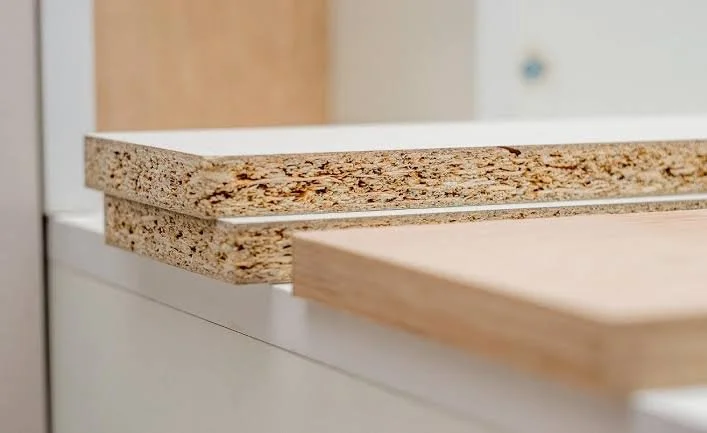
Particle board is the most common material in affordable furniture. Wood chips, shavings, and sawdust are compressed together with adhesive resins, typically containing urea-formaldehyde, and formed into sheets. These sheets are then cut to shape and typically covered with laminate or veneer to look like solid material. The adhesive resins are what hold the particles together, and these resins are what release formaldehyde gas over time.
MDF (medium-density fiberboard) is similar to particle board but uses finer wood fibers compressed at higher density. It creates smoother surfaces than particle board, takes paint well, and is widely used in children's furniture. Like particle board, it contains adhesive resins that release formaldehyde gas. MDF is actually denser than particle board, which means it contains proportionally more adhesive resin per cubic inch.
Plywood uses thin layers of wood veneer glued together in alternating grain directions. It's stronger than particle board and more dimensionally stable than solid wood in certain applications. Quality plywood can be quite durable. But like particle board and MDF, the adhesive between layers typically contains formaldehyde-based resins.
Laminate and veneer are surface treatments, not structural materials. A thin layer of plastic laminate or real wood veneer is applied over particle board or MDF to create the appearance of a different material. That "oak" dresser might be a paper-thin layer of oak-printed laminate over particle board. The listing says "oak finish" rather than "solid oak" and most consumers don't notice the distinction.
The practical difference between these materials extends far beyond aesthetics. It determines how long the furniture lasts, what it releases into your home's air, whether it can be repaired, and how it performs under the stresses that children's furniture specifically endures.
How Materials Affect Your Indoor Air
The air inside your home is typically two to five times more polluted than outdoor air, according to EPA research. Furniture is one of the primary contributors to this indoor pollution.
Formaldehyde is the primary air quality concern with engineered wood products. The urea-formaldehyde resins used to bind particles in particle board, MDF, and plywood continuously release formaldehyde gas at room temperature. This process, called off-gassing, is most intense when furniture is new but continues at lower levels for years.
Formaldehyde exposure causes eye, nose, and throat irritation at low levels. At higher levels, it can trigger headaches, respiratory issues, and allergic reactions. Long-term exposure has been associated with certain cancers, which is why formaldehyde is classified as a known human carcinogen by the International Agency for Research on Cancer.
That chemical smell when new furniture arrives is literally the off-gassing you can detect. But formaldehyde continues releasing at levels below what your nose detects long after the obvious smell fades. The absence of smell doesn't indicate the absence of off-gassing. It indicates that off-gassing has decreased to levels your nose can't perceive but your body still processes.
Furniture finishes contribute additional volatile organic compounds. Traditional paints, stains, lacquers, and polyurethane coatings contain solvents that evaporate into your home's air. These VOCs contribute to indoor air pollution and can cause respiratory irritation, headaches, and longer-term health effects depending on the specific compounds and exposure levels.
Temperature and humidity affect off-gassing rates. Higher temperatures increase formaldehyde release from engineered wood products. This means summer months and heated rooms during winter can both elevate exposure. A child's bedroom that's warm and closed at night creates conditions that maximize off-gassing while minimizing ventilation. This combination is worth considering.
The cumulative effect matters. One piece of particle board furniture might release formaldehyde at levels considered acceptable by current standards. But most rooms contain multiple pieces. A particle board dresser, a particle board bookshelf, a laminated desk, and an MDF bed frame together release substantially more than any single piece. Standards evaluate individual products. Your child's room contains an entire collection.
What to Look For When Choosing Furniture
Armed with this understanding, here's how to evaluate furniture materials practically without needing a chemistry degree.
Ask specifically what the furniture is made from. "Wood" isn't sufficient information. "Solid wood" should mean the entire piece is solid wood throughout, not just the frame or the visible surfaces. If the answer is vague or the seller can't tell you exactly what materials comprise each component, that's informative. Companies that use solid wood throughout are typically proud to say so specifically.
Check for certifications that address chemical emissions. GREENGUARD Gold certification specifically tests for chemical emissions including formaldehyde and VOCs. Products meeting this standard have been independently verified to contribute acceptably low levels of chemical pollutants to indoor air. CARB Phase 2 compliance addresses formaldehyde specifically but allows higher levels than GREENGUARD Gold.
Understand what finish was applied. Zero-VOC finishes contain no volatile organic compounds to release into your air. Low-VOC finishes contain reduced levels but still some. Conventional finishes may contain significant VOCs. The distinction matters because finish contacts air continuously and is the surface your child touches directly.
At AlderBourn, we use Rubio Monocoat zero-VOC oil exclusively. This isn't a marketing distinction. It's an independently verified zero-VOC formulation that bonds molecularly with the wood rather than coating it. The finish becomes part of the wood rather than a layer that sits on top releasing chemicals. This means no off-gassing period. The furniture is safe in your child's room from the moment it arrives.
Examine construction method. Solid wood furniture assembled with proper joinery (dovetails, mortise and tenon, dowels) doesn't require the adhesive-heavy assembly that engineered wood products depend on. Fewer adhesives means fewer sources of chemical emission. The construction method directly influences the chemical profile of the finished piece.
Consider weight as a rough indicator. Solid wood furniture has a distinctive heft. Particle board furniture is often surprisingly heavy but feels different when you move it. MDF is very heavy for its size. These weight characteristics aren't definitive tests, but they provide useful initial information when evaluating furniture in person.
Look beyond the surface. If possible, examine the underside, the back, the inside of drawers. These areas often reveal the actual construction material when the visible surfaces are covered with veneer or laminate. Particle board is easy to identify by its compressed chip appearance. MDF has a smooth, dense, uniform appearance. Solid wood shows grain that's consistent throughout.
The Durability Dimension
Material choice doesn't just affect air quality. It determines how long furniture survives the unique demands of children's use.
Solid wood withstands impact without structural failure. When a toy hits a solid wood surface, it might dent. The dent is cosmetic. The structure remains completely sound. When a toy hits particle board, it can chip, crack, or break through the surface because the compressed particles don't have the structural integrity to absorb impact. The damage is structural, not just cosmetic.
Moisture exposure reveals material differences dramatically. Solid wood can get wet, be dried, and continue functioning normally. It might develop slight swelling that resolves as it dries. Particle board and MDF that get wet swell permanently and irreversibly. The particles absorb water, expand, and never return to original shape. A single significant water exposure can destroy particle board furniture. In a child's room, where spills are inevitable, this vulnerability is a serious practical concern.
Repair potential depends entirely on material. Solid wood can be sanded to remove scratches. It can be refinished to look new. Loose joints can be reglued and clamped. Damaged sections can sometimes be replaced. The material supports indefinite maintenance and repair. Particle board and MDF cannot be meaningfully repaired. Once screws strip (which happens readily because the material is soft and crumbly), they can't be retightened. Once surfaces are damaged, they can't be refinished. The furniture is disposable by material nature.
Structural longevity differs by orders of magnitude. Solid wood furniture with proper joinery commonly lasts fifty to one hundred years or more. Antique solid wood furniture functioning perfectly after a century is normal, not exceptional. Particle board furniture typically lasts three to seven years under normal use, less under the heavy use children provide. This isn't a quality-control issue. It's a material-properties issue. Compressed particles bound with adhesive simply don't have the structural longevity of solid wood.
Making Thoughtful Choices Without Overwhelm
Understanding material differences shouldn't create anxiety about every piece of furniture in your home. It should inform future decisions, not trigger a purge of current possessions.
Prioritize children's bedrooms first. This is where exposure is highest (eight hours nightly) and ventilation is typically lowest (closed doors, closed windows). If you're going to invest in solid wood furniture anywhere, the bedroom is where it makes the most difference for both air quality and durability.
Replace gradually as budget allows and items wear out. When the particle board bookshelf finally fails, replace it with solid wood. When the laminated dresser drawers stop opening smoothly, invest in quality. This approach spreads cost over time and eliminates waste from discarding functional items.
Ventilate rooms with new furniture aggressively. If you have engineered wood furniture, regular ventilation reduces formaldehyde concentration in the air. Open windows when weather permits. Use fans to circulate air. This doesn't eliminate off-gassing, but it reduces your child's exposure to the gases released.
Look for quality secondhand solid wood furniture. Older solid wood pieces have already completed their off-gassing period (if any finish-related off-gassing existed). A secondhand solid wood dresser from a thrift store may be a better choice than a new particle board dresser from a big-box retailer. The older piece has proven its durability by surviving years of use.
When solid wood isn't financially accessible for every piece, prioritize the furniture your child touches most and spends the most time nearest. The bed frame matters more than the decorative shelf. The dresser they open daily matters more than the occasional-use storage bin.
Don't let perfection prevent progress. Having one piece of solid wood furniture with safe finishes in your child's room is meaningfully better than having none. Two pieces are better than one. Gradual improvement over years creates a substantially different environment without requiring a single overwhelming investment.
The Quality Investment
This is where the conversation about materials connects to the conversation about value. Material quality and financial wisdom aren't opposing considerations. They're aligned.
The solid wood bookshelf that costs three times what the particle board version costs also lasts ten times longer, can be refinished rather than replaced, doesn't release formaldehyde into your child's room, can be sold for meaningful value when you're done with it, and potentially serves the next generation. The per-year cost of the quality piece is lower than the per-year cost of the cheap one.
When you understand materials, you understand why quality furniture costs what it costs. Solid alder lumber costs more than particle board. Zero-VOC finish costs more than conventional lacquer. Proper joinery takes more time than cam-lock assembly. These aren't inflated luxury margins. They're the actual costs of better materials and better construction.
At AlderBourn, our Cosmos Collection is solid alder throughout with zero-VOC Rubio Monocoat finish. Not because we're pursuing a premium positioning. Because these materials are what children's furniture should be made from. Solid wood that won't off-gas formaldehyde. Finish that won't release VOCs. Construction that will outlast childhood and potentially serve the next generation.
Understanding what materials are in your home gives you the power to make intentional choices. Not fearful choices. Not panicked replacements of everything you own. Thoughtful, gradual, informed choices that move your home toward materials that serve your family's health, durability needs, and values.
One piece at a time. One replacement at a time. One informed decision at a time. The materials in your home matter. And now you know enough to choose them wisely.
What questions do you have about furniture materials? What factors matter most to you when choosing furniture for your children's spaces? Share your thoughts in the comments.
Every piece in The Cosmos Collection is solid alder with zero-VOC Rubio Monocoat finish. No particle board. No formaldehyde. No chemical off-gassing. Just real wood and safe finish in your child's room. Explore the collection at www.alderbourn.com.
